

You already can. Use sunlight to generate electricity to power a laser. Blah blah “not economically viable” that’s a skill issue. /s
Why hestpumps? I remember seeing a video of a fresnel lens melting rock to lava. That has to be easier and higher temp than 270.
For over a century, the dream of efficiently concentrating low-grade heat into high-temperature industrial energy has been constrained by a stubborn ceiling: 200 degrees Celsius (392 degrees Fahrenheit).
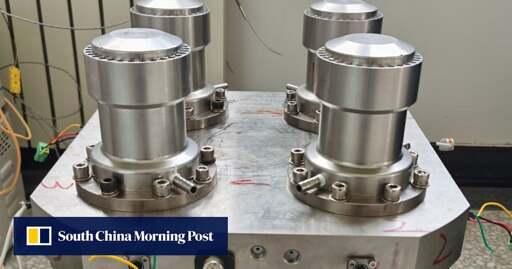
Now, a team from China has shattered that temperature limit. Using a revolutionary heat pump with no moving parts, they achieved an output of 270 degrees with a 145-degree heat source to drive the cycle.…so a modest but significant improvement has been achieved, but nowhere near the temps required for melting ore.
But maaaaybe, theoretically, with materials and technologies not yet developed, possibly by 2040:
In a December 5 article in Nature Energy, Luo summarised various research fronts, including his team’s thermoacoustic Stirling heat pump, as promising pathways towards the realisation of ultra-high-temperature heat pumps.
He also suggested development directions for materials and technologies needed for future ultra-high-temperature heat pumps operating from 600K to 1,600K, or 327 degrees to 1,327 degrees, saying these could be achieved by 2040.Do you know what the phrase “pave the way” means
I’m just tempering the headline, not throwing doubt at the research and development possibilities.
I got excited about the headline, thinking they’d experimentally achieved ore-melting temperatures with a heat pump (“Ultra-hot heatpump breakthrough paves the way […]”).
I guess I perceive 270°C as below the threshold of “ultra hot”.
Later in the article it’s revealed that the breakthrough experiment is paving the way to the (as yet unrealised) ultra-hot (“Luo summarised various research fronts […] promising pathways towards the realisation of ultra-high-temperature heat pumps.”)
Still – 270°C! Commercial/domestic baking ovens when?
How can a heat pump have no moving parts?l
Thermoacoustics.
…so a modest but significant improvement has been achieved, but nowhere near the temps required for melting ore.
Just stack six of these in series, problem solved. /s