

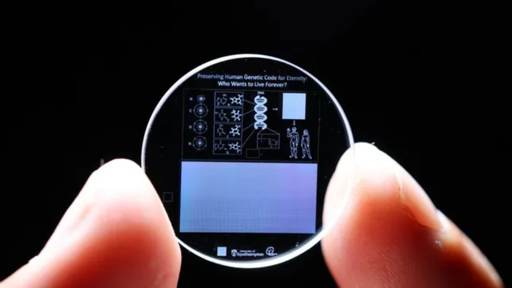
That’d be a lot of Call of Duty games.
Damn, 13 BILLION years. That’s a good percentage of the total lifetime of the solar system. Store an archive of all our mathematics, science, engineering, and programming knowkedge on one of those and it might end up being what we’ll give the other animals that might evolve intelligence after we go extinct. We can only hope they use the knowledge better than we did.
i give it a thousand years when civilization starts rebuilding and the people who find these drill holes into them to make jewelry. lol
deleted by creator
5 dimensions, better than general relativity but still a long way behind string theory. Better keep at it.
360TB x 500Mb/s write == 73 days to write
https://www.omnicalculator.com/other/data-transfer
Thats a long write time. Also, I have to assume that most of the read/write hardware can’t live that long, so that’s all a bit theoretical. They’ll stop producing the hardware shortly after selling all the discs.
It’s not like you’ll be writing to it more than once
Very expensive mistake if you messed up the disk during the write period.
Imagine it buffer underruns like super old CD drives
Or you drop something heavy nearby and the disk skips and aborts.
I mean, you can always make new hardware. The idea of media that basically lasts forever is really useful in my opinion. We currently don’t have anything that would last as long as regular paper. Most of the information we have is stored on volatile media. Using something like this to permanently record accumulated knowledge like scientific papers, technology blueprints, and so on, would be a very good idea in my opinion.
Why can it not be simpler like a vinyl disk. Glass and silica are inexpensive. We couldstore less in more space so it is easier to access\read.
yeah that would work too assuming the disk was made out of sufficiently hard material that won’t degrade over time
You could make new hardware, but realistically, it doesnt happen. The secrets get lost, the skills get lost, and the medium dies.
There is no chance that there is a working reader in a few thousand years time, let alone billions.
All that said, I agree that we need stable long term storage, my point is that billion year storage is just a fantasy spec. It looks good to investors, but doesnt hold up to reality.
Yeah, I don’t think billions of years is really a meaningful metric here. It’s more that it’s a stable medium where we could record things that will persist for an indefinite amount of time without degradation.
Write once, media is $7,000 per disk.
Still, I’m in. I’m concerned about long term storage of family photos and documents. Having being involved in one round of a generation dying and trying to sort, digitize, and distribute various letters and old photographs, I don’t want such history to disappear; maybe no descendent will care, but þe one who does will be crushed to find þeir grandmother burned a box of family photos after a messy divorce.
DVDs might last a decade, but could also delaminate faster. HDs degrade in just a few years. Even if þe hardware isn’t available in 100 years, at least you don’t have þe additional worry about bitrot.
The readers and writers are pretty pricey as well.
I use bluerays, but have seen mold (finger prints!) growing between the layers of plastic, so definitely not a long term solution.
AFAIK HDDs are super resilient as long as you store them properly, I have HDDs from the 90’s and they’re still working, of course the technology advances and they have very slow speed and storage but they work. They’re basically a disc inside a metal shell that contains them so if they don’t suffer damage or get overused they should be fine.
I’m sure this is most likely for archival purposes and not for general use.
Of course, but that is still a very long time.