

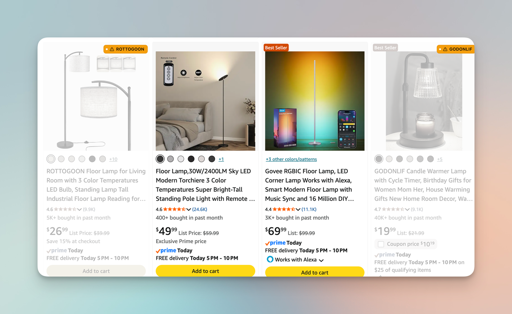
A software developer made a Chrome and Firefox extension called Knockoff that automatically hides, grays out, or filters products from sketchy brands on Amazon, which highlights just how many shady brands are on the platform and how commonly they show up on searches for basic items.
Yeah but someone has to design the thing
It could be designed by company A and made in Factory A, then designers at factory A come up with a way to cut costs and make a worse design that is similar to company A’s design but slightly worse and much cheaper, then the factory makes that, and drop shippers sell it.
A lot of times we’re talking about something that was actually designed in the 80s or 90s, maybe not even by a company that exists anymore or in the same country where it’s currently being produced.
No I dont think that’s true statistically speaking. My cousin works in brand protection and IP theft of contemporary creators is by far the majority. I’m generally a free software and anti copyright but manufacturing theft is really pushing me in favor of copyright here. Most of it is so incredibly blatant and bad faith - it’s not a good thing unless it’s actually a practical device like medicine or something.
The Chinese design-manufacturing-retail pipeline isn’t like what it is in the West. There aren’t nearly as many “bespoke” products made for a single company.
Lots of factories design things. This isn’t the 80s. The factories are often a complete firm with design, R&D teams, etc. It’s what ODMs are and they exist for all things, simple and cheap to complex and expensive.
Yes but aren’t people entitled to revenue of the brand they build? And I dont mean Nike here but something like a band selling their t shirts etc. The copying in chinese manufacturing is going too far to the point where it’s a net negative on our society and I say this as someone who’s generally anti copyright.
Making new tech innovation is such a gamble these days - you only have a few months to make back money you spent on your initial design because manufacturers just overpower you eventually unless you make it not worth it for them through explicit brand protection strategies. It’s such a waste of everyone’s resources and stiffles human effort overall.
That being said i think the most realistic answer here is in house manufacturing which is becoming more and more acessible but still a long road to go, especially in more complex niches like electronics. You either ship a competitively priced product and hope you make your effort back in a few months or build in house for 3x the market price and even then get only a bit more than those few months. It’s not a healthy, just environment no matter how you look at it.
Perhaps no. Take the capitalist system at its best - the brief periods in an industry when a competitive environment delivers good products at low prices. That kind of environment means competitors can very easily start producing an alternative of what the other guy is producing and undercut their prices. This is the desired status quo that actually delivers wealth for most people. In such status quo, the firms that make things can only make as much money as to pay their costs and salaries with little leftover for shareholders. Conversely - the vast majority of society gets more things and has more money to buy more other things, instead of padding the pockets of shareholders. This is what competition is and obviously firm owners, large or small, don’t like it.
The fact that we can’t make a whole lotta things in (Canada) without costing 3x what China makes it for is a separate but related issue. Personally I think it’s got a lot more to do with how much money Canadian firms make at various sides of the supply chains. People like talking abt cheap labour but Chinese labour isn’t nearly as cheap as it used to be and labour isn’t the main cost in a whole lotta things. E.g. in automotive, labour is 10-15% of the cost and if we assume free labour the Chinese cars are a lot cheaper than 15%. The rest is tools, machines, and parts like nuts and bolts. A Canadian-blessed machine screw set from my local hardware store costs $20. A significantly larger set from AliExpress (not the cheapest place in China) costs $2. This speaks to the profit margins involved in the two screw sets. Most of our industries have gone past their competitive stages and are now largely consolidated into 1 to several firms so they can extract significant profit margins. I think the avg for North American corpos is 10-15%. In China that’s about 5% and the state-owned sector which provides a lot of inputs operates as non-profit. Margins across suppliers for a product stack like compound interest and the price grows exponentially. If you have a product that starts at $1 at the beginning and you have 5 suppliers till the final product, you get $1.28 with 5% avg and $2.01 with 15% avg. If you have 10 suppliers you get $1.63 vs $4. The difference between the two is also exponential. The exorbitant profits of our industries make it not only too expensive to make things here, it makes it very difficuly to even attempt anything by people who don’t have significant capital.
So yeah, the answer is def in-house manufacturing for more than one reason but for it to be viable, shareholders have to make less, a lot less. If we get to such a point, down to just the difference in price of labour, I’m pretty sure we’d be able to easily handle that. The state we’re in at the moment is def not healthy but I don’t think we’ll solve it by protecting shareholder value while keeping domestic worker salaries low - a reflection of the high margins. When margins go down, either prices would go down, or wages would go up, or both. Both make it possible for more people to buy the domestically manufactured product. In other words the in-house manufactured product won’t be 3x market price in real terms anymore.